The Bridge Framework:
From Principles to Practice
Ten practical pillars that bridge the gap between ethical principles and real-world compliance—giving your team a clear, structured pathway to responsible AI deployment.
The Bridge Framework represents a highly practical approach to AI governance. We turn abstract values into actionable, everyday guidance that helps organisations identify vulnerabilities, map regulatory compliance, and act with absolute confidence.
Why "Bridge"?
Connecting ethical aspirations with operational reality.
The AI ethics landscape suffers from a critical gap: abundance of principles, scarcity of implementation guidance. Organisations know they should govern AI responsibly—but struggle with how to operationalize abstract values into concrete practices.
The Bridge Framework addresses this gap by breaking governance down into 10 clear, integrated areas, providing:
Evidence-Based Foundation
Every pillar and recommendation derives from systematic evaluation of 100+ existing frameworks, peer-reviewed research, and empirical validation. Not aspirational theory—proven methodology.
Actionable Assurance
The framework is backed by an interactive assessment and remediation pipeline, allowing your organisation to continuously monitor and improve technology safety.
Regulatory Harmony
Comprehensive mapping to EU AI Act, GDPR, UK Data Protection Act 2018 / UK GDPR, NIST AI RMF, ISO 27001, IEEE standards, and more. One framework, multiple compliance requirements satisfied.
The Complete Product Lifecycle
The 10-Pillar Bridge Framework serves as our rigorous academic blueprint. This blueprint is operationalised through the Ethos Product Lifecycle — four continuous stages of governance designed to map directly to enterprise risk reality.
Ethos Diagnose
The foundational baseline assessment across all 10 governance pillars.
Ethos Assure
Continuous, agentic monitoring and policy-to-action tracking.
Ethos Intelligence
Multi-scenario stress-testing and strategic decision wargaming.
Ethos Field
Offline Edge AI for disconnected, mission-critical environments.

Ethos vs. Standard Governance
Evidence-Based (ETHOS)
Built on over 30 years of technology governance research and direct evaluations of over 100 regulatory frameworks. Validated empirically through live deployments in public and private institutions.
Aspirational Theory
Relies on abstract ethical principles, unverified checklists, and retrospective incident handling without proactive, continuous architectural verification.
See the Framework in Action
Watch our documentary-style video essays that bring AI governance challenges and solutions to life with real-world examples and expert analysis.
AI Unchecked: The Urgent Need to Regulate AI
Explore how AI systems can perpetuate bias and why rigorous governance is essential—with parallels to pharmaceutical and aviation regulation.
Expanding Video Library
We're curating more than 50 specialist documentaries and video essays organised by framework pillars, industry sectors, and implementation topics.
Prefer learning through video? Our documentary-style essays make complex governance topics accessible and engaging.
Map Your Risks to the 10 Pillars
Take our AI Risk Assessment to identify vulnerabilities across bias, transparency, security, and operations. Get tailored recommendations mapped directly to the ETHOS Bridge Framework pillars below.
Bias & Fairness
Pillars 3, 7
Transparency
Pillar 6
Security & Privacy
Pillar 5
Operations & Safety
Pillars 4, 9
Ten integrated pillars
Comprehensive governance across technical, ethical, and operational dimensions.
Accountable Governance and Ethical Leadership
Establish clear accountability structures and ethical oversight for AI systems.
Purpose-Driven and Rights-Based Innovation
Ensure technological advancement is intentional, beneficial, and respects fundamental human rights.
Human Agency and Oversight
Augment human capabilities while preserving dignity and meaningful control.
Systemic Safety and Reliability
Engineer systems to be safe, secure, and reliable across diverse and adversarial conditions.
Data Integrity and Privacy
Ensure training data is accurate, representative, and handled with strict privacy protocols.
Algorithmic Transparency and Explainability
Disclose system capabilities and provide comprehensible rationale for automated decisions.
Continuous Assurance and Adaptation
Implement ongoing monitoring to ensure systems remain safe, effective, and ethically aligned.
Equitable Impact and Societal Well-being
Assess and govern the systemic effects of AI on social equity and collective psychological health.
Ecosystem Accountability and Market Fairness
Promote a healthy, fair, and diverse technological ecosystem free from anti-competitive practices.
Global and Cultural Context
Ensure governance architectures are culturally aware, adaptable, and globally inclusive.
Ethical Leadership & Governance
Establish accountability structures
What It Means
Establish clear accountability structures, decision-making authority, and governance oversight mechanisms that embed ethical considerations into organisational leadership.
Why It Matters
Without governance authority and accountability, even the best frameworks remain aspirational. This pillar ensures AI ethics has organisational power and resources.
Key Components
- Governance committee structures and RACI matrices
- Executive accountability and decision authority
- Board oversight and reporting mechanisms
- Resource allocation and budget authority
- Escalation protocols and dispute resolution
Implementation Support
Regulatory Alignment
Maps to EU AI Act Articles 9-10 (risk management and quality management), ISO 27001 governance requirements, NIST AI RMF Govern function.
Purpose-Driven & Value-Aligned Innovation
Align AI with organisational mission
What It Means
Ensure AI initiatives align with organisational mission, values, and stakeholder interests—not just technical feasibility or commercial opportunity.
Why It Matters
AI deployed without clear purpose or values alignment creates mission drift, stakeholder distrust, and ethical risks that undermine both reputation and effectiveness.
Key Components
- Mission-AI alignment assessment
- Stakeholder value articulation
- Purpose definition frameworks
- Use case ethical screening
- Values-based design principles
Implementation Support
Regulatory Alignment
Maps to EU AI Act recitals on human-centric AI, OECD AI Principles on inclusive growth and human-centred values.
Human-Centricity & Agency
Preserve human autonomy and dignity
What It Means
Preserve human autonomy, dignity, and decision-making authority in AI systems—ensuring humans remain in control and AI augments rather than replaces human judgment.
Why It Matters
Research indicates that approximately two-thirds of consumers express concern about AI use by businesses. Surveys show 69% of U.S. adults lack interest in AI-powered consumer tools, highlighting the trust gap that effective governance must address. Preserving human agency builds trust while preventing automated harms and maintaining accountability. (Emarketer, 2024; Gallup, 2024)
Key Components
- Human-in-the-loop mechanisms
- Override and appeal processes
- Informed consent frameworks
- Autonomy preservation protocols
- Human oversight requirements
Implementation Support
Regulatory Alignment
Maps to EU AI Act Article 14 (human oversight), GDPR Article 22 (automated decision-making), IEEE 7000 series on human wellbeing.
Safety, Robustness & Reliability
Ensure technical excellence
What It Means
Ensure AI systems perform reliably under varied conditions, fail safely when they do fail, and undergo rigorous testing before deployment.
Why It Matters
Significantly fewer project failures with mature governance. Research shows external partnerships and systematic governance practices nearly double success rates—from 33% to 67%. Technical excellence prevents catastrophic failures, protects investments, and builds stakeholder confidence. (MIT, 2025)
Key Components
- Testing and validation protocols
- Performance monitoring systems
- Failure mode analysis
- Robustness testing (adversarial, edge cases)
- Incident response procedures
Implementation Support
Regulatory Alignment
Maps to EU AI Act Articles 9, 15 (accuracy, robustness, cybersecurity), NIST AI RMF Measure and Manage functions, ISO 27001 operational controls.
Data Governance & Privacy
Protect information rights
What It Means
Implement systematic data management practices that protect privacy, ensure data quality, and maintain legal compliance throughout AI system lifecycles.
Why It Matters
Poor data governance creates legal liability (GDPR fines up to €20 million or 4% of global annual turnover, whichever is higher—Article 83, Regulation EU 2016/679), technical failures (garbage in, garbage out), and reputational harm.
Key Components
- Data inventory and classification
- Privacy impact assessments
- Data minimization and retention
- Access controls and security
- Data quality assurance
Implementation Support
Regulatory Alignment
Maps to GDPR Articles 5, 25, 35 (principles, data protection by design, DPIAs), EU AI Act Article 10 (data and data governance), NIST Privacy Framework.
Transparency & Explainability
Build trust through clarity
What It Means
Provide clear information about AI system operations, decisions, and limitations to stakeholders—enabling informed consent, accountability, and trust.
Why It Matters
Opacity breeds distrust and prevents accountability. Transparency enables stakeholders to understand, challenge, and trust AI systems appropriately.
Key Components
- System documentation standards
- Explanation mechanisms (technical and non-technical)
- Transparency reporting frameworks
- Disclosure protocols
- Algorithmic impact statements
Implementation Support
Regulatory Alignment
Maps to EU AI Act Articles 13, 52 (transparency and information provisions), GDPR Articles 13-14 (information to data subjects), IEEE 7001 on transparency.
Social Impact & Global Equity
Address systemic inequalities
What It Means
Address systemic inequalities, prevent discriminatory outcomes, and ensure AI benefits are distributed equitably across communities and populations.
Why It Matters
AI systems can perpetuate or amplify existing inequalities. Proactive equity measures prevent algorithmic discrimination and ensure AI serves all stakeholders fairly.
Key Components
- Bias detection and mitigation
- Fairness metrics and evaluation
- Equity impact assessments
- Inclusive design processes
- Stakeholder representation
Implementation Support
Regulatory Alignment
Maps to EU AI Act prohibited practices (Article 5) and high-risk system requirements (Article 10), OECD AI Principles on inclusive growth, UNESCO AI Ethics Recommendation.
Environmental Sustainability
Minimise Ecological Footprint
What It Means
Minimise AI systems' environmental footprint through energy-efficient design, carbon accounting, and lifecycle environmental impact assessment.
Why It Matters
AI training and operation consume significant energy. Responsible AI governance must address environmental sustainability alongside other ethical dimensions.
Key Components
- Energy consumption monitoring
- Carbon footprint calculation
- Green computing practices
- Sustainable infrastructure choices
- Lifecycle environmental assessment
Implementation Support
Regulatory Alignment
Maps to emerging EU sustainability reporting requirements, ISO 14001 environmental management, responsible computing frameworks.
Continuous Assurance & Lifecycle Management
Maintain governance over time
What It Means
Maintain governance effectiveness throughout AI system lifecycles through continuous monitoring, periodic reassessment, and adaptive management.
Why It Matters
Governance is not 'set and forget.' AI systems, contexts, and risks evolve—requiring ongoing assurance that governance remains effective over time.
Key Components
- Continuous monitoring systems
- Periodic governance audits
- Change management protocols
- Version control and documentation
- Retirement and decommissioning procedures
Implementation Support
Regulatory Alignment
Maps to EU AI Act Article 61 (post-market monitoring), ISO 27001 continual improvement requirements, NIST AI RMF continuous monitoring guidance.
Global and Cultural Context
Ensure governance is culturally aware
What It Means
Ensure governance architectures are culturally aware, adaptable, and globally inclusive by accounting for diverse cultural values, legal traditions, and local realities.
Why It Matters
A governance framework claiming global leadership cannot operate from a Western-centric worldview. It must navigate the tension between global data flows and digital sovereignty.
Key Components
- Culturally adaptable implementation guidelines
- Global advisory council representation
- Privacy-preserving cross-border technologies
- Digital sovereignty policy alignment
Implementation Support
Regulatory Alignment
Maps to UNESCO Recommendation on the Ethics of AI (cultural diversity principles) and regional cross-border data transfer regulations.
ten pillars. One Integrated System.
The Bridge Framework pillars don't operate in isolation—they form an integrated governance ecosystem.
Effective AI governance requires integrated thinking. Transparency (Pillar 6) depends on data governance (Pillar 5). Human agency (Pillar 3) requires clear accountability structures (Pillar 1). Social equity (Pillar 7) connects to purpose alignment (Pillar 2).
The Bridge Framework explicitly maps these connections, ensuring organisations build coherent governance systems rather than disconnected policies.
Key Integrations
- Leadership → All Pillars: Governance structures enable all other pillars
- Data ↔ Privacy ↔ Transparency: Information management trilogy
- Safety ↔ Reliability ↔ Continuous Assurance: Technical excellence cycle
- Purpose ↔ Human Agency ↔ Social Equity: Values alignment cluster
Systems thinking, not checklist approach
Your Path from Principles to Practice
Choose the implementation pathway that matches your organisation's maturity and needs.
Quick Start
30 Days
For:
SMEs, organisations new to AI governance
Focus:
High-impact quick wins and foundational policies
Outcome:
Basic governance framework operational in one month
Key Steps:
- Complete maturity assessment
- Establish governance committee
- Implement 3 priority pillar policies
- Deploy basic monitoring
Comprehensive Build
Enterprise Implementation
RECOMMENDEDFor:
Enterprises, public sector, mature organisations
Focus:
Full 10-Pillar implementation with deep integration
Outcome:
Enterprise-grade governance system fully operational
Key Steps:
- Comprehensive assessment and gap analysis
- Full governance structure implementation
- All 10 pillars deployed with integration
- Staff training and capability building
- Certification preparation
Continuous Improvement
Ongoing
For:
Organisations with existing governance seeking enhancement
Focus:
Gap filling, optimisation, certification
Outcome:
Mature governance with continuous assurance
Key Steps:
- Maturity reassessment
- Gap identification and prioritization
- Targeted pillar enhancement
- Advanced monitoring and reporting
- Certification achievement
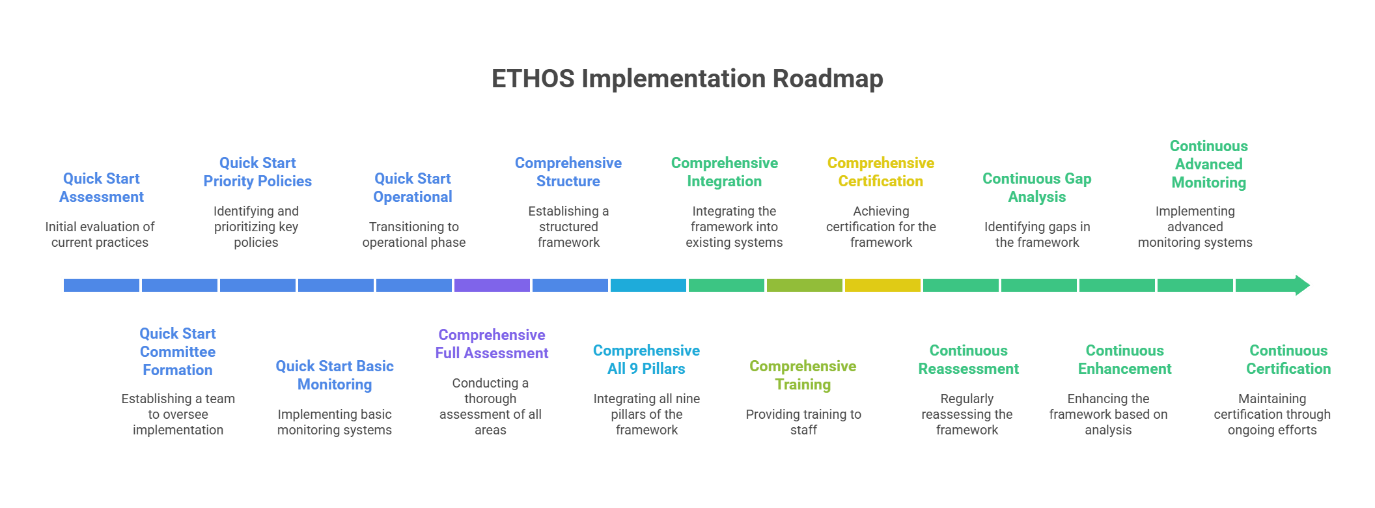
Implementation Roadmap
Maturity Assessment
Assess existing technological maturity, pinpoint architectural gaps, and establish baseline risk telemetry.
Governance Design
Customise framework pillars, define operational policies, and establish formal oversight bodies.
Integration & Controls
Deploy auditing tools, train teams, and embed checks within development CI/CD pipelines.
Continuous Monitoring
Perform recurring audits, compile compliance telemetry, and iterate controls dynamically.
One Framework. Multiple Compliance Requirements.
Comprehensive mapping to EU AI Act, GDPR, NIST AI RMF, ISO standards, IEEE guidelines, and more.
| Bridge Framework Pillar | EU AI Act | GDPR | NIST AI RMF | ISO 27001 | IEEE 7000 |
|---|---|---|---|---|---|
| 1. Ethical Leadership & Governance | Art. 9-10 | Art. 24, 32 | Govern | Clause 5-7 | organisational |
| 2. Purpose-Driven Innovation | Recitals | - | Plan | Clause 4 | Values |
| 3. Human-Centricity & Agency | Art. 14 | Art. 22 | Govern | - | Wellbeing |
| 4. Safety, Robustness & Reliability | Art. 9, 15 | Art. 32 | Measure, Manage | Clause 8 | Safety |
| 5. Data Governance & Privacy | Art. 10 | Art. 5, 25, 35 | Map | Clause 8 | Privacy |
| 6. Transparency & Explainability | Art. 13, 52 | Art. 13-14 | Map | - | Transparency |
| 7. Social Impact & Global Equity | Art. 5, 10 | - | Measure | - | Equity |
| 8. Environmental Sustainability | - | - | - | ISO 14001 | Sustainability |
| 9. Continuous Assurance | Art. 61 | Art. 32 | Measure, Manage | Clause 9-10 | Assurance |
| 10. Global and Cultural Context | Art. 9 | Art. 44-49 | Govern | - | Diversity |
Our Regulatory Alignment Tool allows you to select applicable regulations and generate a detailed mapping showing how the Bridge Framework addresses each requirement. This systematic approach reduces compliance burden while ensuring nothing falls through gaps between frameworks.
Everything You Need to Implement
Templates, checklists, playbooks, and training materials for each pillar.
Assessment & Planning
- Governance Maturity Assessment
- Gap Analysis Tools
- Implementation Roadmap Templates
- Resource Planning Guides
Policy & Procedure
- Policy Templates (customisable)
- Standard Operating Procedures
- Documentation Standards
- Approval Workflow Templates
Role-Based Playbooks
- Chief AI Officer Playbook
- CISO/Security Leader Playbook
- Compliance Officer Playbook
- Product Manager Playbook
- Data Scientist Playbook
Training & Capability
- Executive Briefings
- Staff Training Modules
- Technical Deep Dives
- Certification Preparation
Our Implementation Toolkit transforms the Bridge Framework from methodology to operational reality. Every template is designed for customisation to your organisational context, every playbook tested with real-world implementations.
Bridge Framework Certification
Independent verification of governance maturity and framework adherence.
Certification Benefits
- Independent credibility signal to stakeholders
- Detailed assessment report with improvement recommendations
- Public certification badge and directory listing
- Regulatory confidence (demonstrates systematic governance)
- Competitive differentiation in responsible AI
Certification Levels
Foundation Level
Basic governance structures and key policies in place
Practitioner Level
Comprehensive 10-Pillar implementation with integration
Expert Level
Mature governance with demonstrated effectiveness and continuous improvement
Frequently Asked Questions
Find answers to common questions about the Bridge Framework.
From Theory to Software: The Ethos Brain
How does a theoretical 10-Pillar Framework actually execute inside a secure institutional environment? Watch the architectural masterclass.
The 10 Pillars in Action: A 5-Minute Technical Deep Dive
Start Your Governance Journey Today
Take the first step toward evidence-based AI governance.
Not Legal Advice
The information provided on this page regarding regulatory requirements, compliance obligations, and legal frameworks is for general informational and educational purposes only. It does not constitute legal advice and should not be relied upon as such. Regulatory requirements vary by jurisdiction, industry, and specific circumstances. Always consult with qualified legal counsel familiar with your jurisdiction and specific situation before making compliance decisions.